St.
Luke's is the oldest Episcopal Church in Montclair. During the early
19th century, English settlers working in local mills in the area
which eventually became Montclair arranged for religious services
and Sunday School instruction in accordance with the Church of
England. These services were first conducted in a schoolhouse that
had been built in 1825 for children of the mill workers. In 1846, an
Episcopal Church, named St. Luke's was built on local property at a
cost of $3,500. This frame structure was damaged by fire in 1854 and
by 1858 had been restored to what was described as a "comfortable
and respectable House of Worship."
On Easter Monday in April 1860, the present parish was formally
constituted and incorporated as "The Rector, Wardens and Vestrymen
of St. Luke's Church." Two wardens and five vestrymen were elected
at that time, and St. Luke's was admitted to the union of the
Protestant Episcopal Church at the convention of May 1860. The Rev.
Mr. Henry Marsh was the first Rector of the newly established church
in that same year, when the village where St. Luke's was located
underwent a name change from West Bloomfield to Montclair. In less
that five years, the restored church was outgrown. However, a gift
of two acres on what is now St. Luke's Place, off Bloomfield Avenue,
was given to the parish by Robert Hening in 1860. The cornerstone
for the new
church was laid on May 15, 1865, but work had to be suspended until
1869 owing to building expenses of $10,000. The Rev. James Maxwell
had been Rector for two years when he celebrated the first service
in the church on Easter Sunday in April 1870.
During the Civil War, St. Luke's began a history of establishing
missions by conducting services in nearby Cedar Grove. To
accommodate parishioners who had moved to Upper Montclair, St. James
Church was created in 1888. Other missions were later established at
St. John's and Trinity in Montclair and St. Peter's in Essex Fells.
By 1884, the congregation had outgrown the facilities. At a
meeting of the Vestry in September of 1885, William Fellows offered
the present site of St. Luke's at Union Street and South Fullerton
Avenue. The cornerstone for this building was laid on June 13, 1889
by the Rt. Rev. Thomas A. Starkey, D.D., Bishop of the Diocese of
Newark, assisted by Mr. Carter. The first service in our present St.
Luke's Church, designed by R.H. Robertson, was held on the first
Sunday in Advent, November 30, 1890.
The first Parish House was begun in 1883 to provide assembly
space for the church School and was connected to the church by a
covered cloister. The Tudor style rectory was constructed on the
grounds in 1907. The present Parish House was opened in 1923. The
interior of the Church was redesigned by Hobart Upjohn that same
year and the roof was literally raised so as to transform the
structure from the Victorian Gothic to the pure Gothic, pillared
style that we see today. Several Tiffany windows were also added.
The "new" church was dedicated on November 24, 1929.
Prior to World War I, St. Luke's developed (as every town
congregation would with Sunday worship) a large and excellent choir,
education for children and women's and men's groups meeting
regularly. However, consistent with the development of Montclair as
a modern, progressive community, St. Luke's entered the 1920's with
new emphasis on diversity and social justice. In 1919 pew rents were
abolished is favor of the tithe and pledge. In that same year, we
established Trinity Mission, assisting the African-American
population of Montclair in buying and rehabbing a former armory on
Willow Street for the new Church and offering continuing financial
support. Stemming from the war effort, the women of the parish
continued their work as a Red Cross annex and began the practice of
sharing food baskets with those in need at holiday time.
I n the 1930's
and 40's, internal growth occurred with women's study groups, a
Junior Branch and Young People's Fellowship. A Food Pantry was begun
as well. By 1950, with the Cold War raging, ministry at St. Luke's
concentrated on housing the homeless as we took in war refugees,
providing housing, tutoring and employment opportunities for
Lithuanian, German and Hungarian families.
By the 1970's, the people of God at St. Luke's were moving
forward with both inward stability and outward growth. The women
began the Second Time Around Shop which continues to provide
affordable clothing and household items to the wider community;
great music programs were provided by the growing choir; liturgical
change began with Prayer Book drafts. In the late 1980's, along with
the food pantry, a noonday feeding program began; this continues
today as a parish ministry of hospitality as Toni's Kitchen, using
both parish and community volunteers.
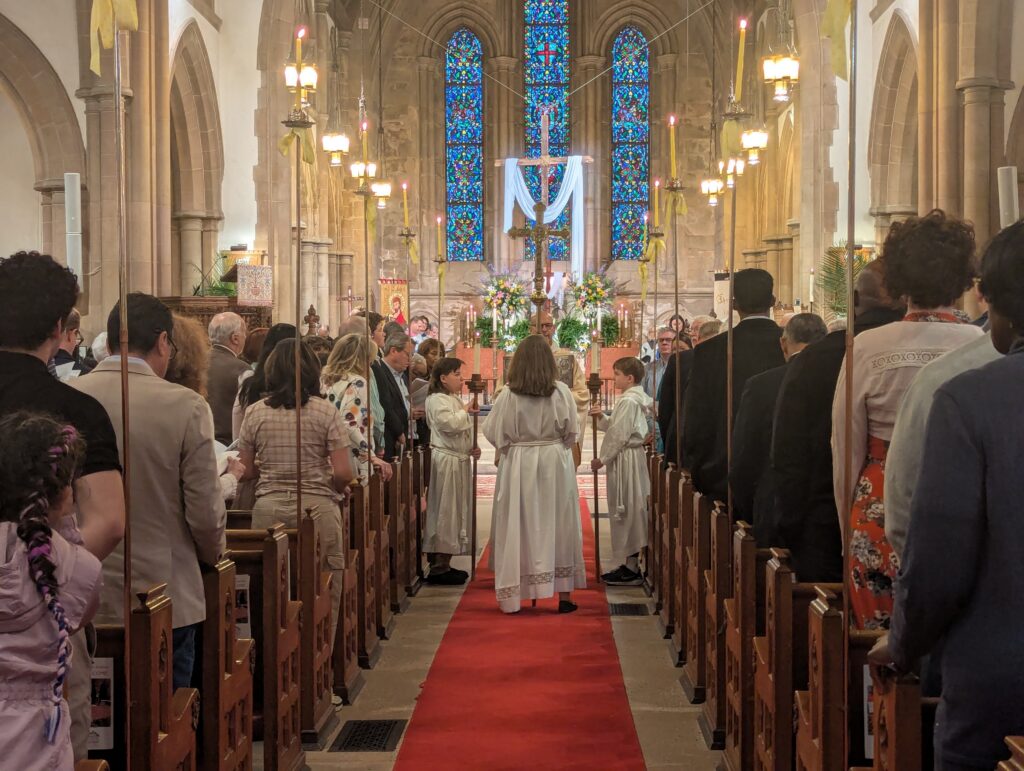
TODAY, St. Luke's Faith Community is grounded in commitment to
celebrating a unique mix of people through caring, education and
ministry. The wide spectrum of the human family is represented on
Sunday mornings at the Holy Table. We offer Christian Formation
though our progressive programs such as the Second Saturday Series;
we minister to the wider community through such events as our highly
acclaimed lunch program at Toni's Kitchen and our thriving and busy
thrift store, the Second Time Around Shop.
St. Luke's is a congregation that honors its roots, grows in its
faith commitment, and celebrates the richness of diversity of those
on the faith journey. You are invited to be a participant as we make
church history together!

|
|

|